

Searching for Nyai roro Kyol - Bandung

Sunday, July 19, 2026
It all started with an idea.
If time left an imprint, where would you choose to stay?
I mean in terms of encounters.
When I was doing research online and stumbled upon Nyi Roro Kidul, along with the fact that people had created choreography for her, I became determined to go to Indonesia to learn. Learn from whom? Stay where? I had no idea. All I knew was that I would land in Jakarta, which meant Java. I started asking every Indonesian I met, and they told me I should go to Jogja, as it is the cultural heartland of the Sundanese people. True, I might have learned more dance styles there, but I would have missed her ocean.

Then, a friend replied within an hour. Through a chain of mutual connections, that dancer was found on Instagram. At first, we tried calling, but our English wasn’t enough to communicate fluently, so we relied on a translation app. She said, "I am just a dancer. I need to ask the choreographer if they're willing to share the dance, and besides, that was many years ago." I told her it didn't matter. I remember asking her: "Why do you like the Mermaid Queen?" She said she was a practicing Muslim. Yet, even within a single faith, she still wanted to preserve her local culture and her reverence for the divine feminine. She mentioned that I could come to the place where she teaches children to learn. From that moment, we decided I would make the trip to her hometown.
We kept track of each other's lives on Instagram, wanting to catch glimpses of one another's worlds. I saw her put on traditional attire every week to dance, often leading performances with children. I asked her, "If I come, would you want to hold a private class for me? How should I pay you?" She replied that she wanted to be my collaborator. Later, I realized that she, her family, and her entire artistic circle treated me like a close friend—a relationship built entirely outside the concept of money. So, how should I set off? Besides learning, what else could I do there? How would we collaborate, and on what? What kind of landscapes would I see? Before landing, everything was a complete unknown.
I left at 6:00 AM. After a five-hour flight, a one-hour car ride, and a one-hour train journey, I finally met my internet friend in person. They arrived on "scooters" (motorbikes)—one carrying my luggage, the other carrying me—and together we rode to the Airbnb. They said their entire afternoon was reserved for me, and I finally understood why: they take things one step at a time, and they were genuinely excited about this trip.
After dropping off my bags, we went to a local Sundanese restaurant. The squid, fish, chicken, and soy products were all fried or wrapped in banana leaves. Flies kept buzzing around the eatery, and whenever they apologized, I said, "It's totally fine," and we all started eating with our hands. (The grilled squid was truly delicious!) We discussed the itinerary, which included attending a university dance department graduation show and practicing dance. Rumy mentioned that they had researched a beach, but it was a bit far—about a 6-hour drive. It’s ok for me. We Bandung dancers are used to sleeping in the car. We can drive at night and dance in the morning. Then drive back… but I thought driving 12 hours round-trip was too exhausting, so I suggested searching for a hostel to stay overnight instead. Meanwhile, they mentioned a sacred room dedicated to the goddess, and they even knew the caretaker. Wawa immediately started contacting the caretaker while Romy looked into renting a car. They mentioned the car rental and driver were a bit expensive. I said, "Let’s ask for the price first if you guys are interested. We can even make a dance film at the beach." We then split up to handle different tasks.
After I arrived at the Airbnb, OMG, it had no hot water! I texted Wawa. During dinner, she had asked if I wanted to stay at her place, and I had said let's check the Airbnb first. But finding no hot water in 14°C weather—and knowing the Airbnb could be refunded—felt almost pre-arranged when I looked back. Everything felt meant to be. So, after confirming with Wawa, I checked out of the Airbnb and moved to her home the next morning.
I rode on a motorbike through bustling train station markets, rice paddies, and narrow alleys, eventually arriving at a farmstead. Imagine your internet friend giving you an address that sits somewhere inside a village, but nothing maps out correctly. There were no paved roads, only paths wide enough for motorbikes. I had to ask passersby where her house was, but with the language barrier, all I could do was repeat her name: "Wawa, Wawa." An elderly grandmother immediately stepped out from a courtyard and led me to the other end of the lane. After winding through thirteen bends, a row of connected houses came into view. A middle-aged man stepped out and greeted me warmly.
To be honest, I was a bit startled by the surroundings. I kept taking photos along the way to confirm with Wawa, and only felt relieved enough to drop my bags when he called her sister so I could hear a familiar voice. They went up to rest in a room on the second floor. At that point, I hadn't met her children or the rest of her family yet, and her husband wasn't around. The room contained nothing but a mattress on the floor—bare walls and empty space, which seemed to be a characteristic feature of their living space. To us, "bare walls" might sound like a negative description, but in their eyes, having a room to shelter in was already wonderful.
After dropping off my luggage, her father drove me directly to the dance studio on his motorbike. Initially, I had planned to hail a ride-share. Looking back, getting driven to an unfamiliar place by a stranger feels a bit surreal, but at that moment, there was a deep sense of trust—partly from their warmth, and partly from the initial faith I placed in the journey.
We quickly arrived at the dance school, situated in a small town beyond the fields behind the train station. Everyone greeted me with incredible warmth, preparing lunch and asking what I liked to eat. The principal of the dance school, his daughter, and his wife all came out to welcome me. While waiting for lunch, we shared a warm-up session together. He shared traditional dance warm-up movements, while I shared contemporary techniques. It was a beautiful beginning that continued throughout the day. Over lunch, they were full of excitement, asking why I had come. I kept saying I was brave to travel to Bandung all by myself. At that moment, I didn't overthink things; it was built on trust in my friends and a strong sense of intuition. That day, we learned four minutes of choreography very quickly.
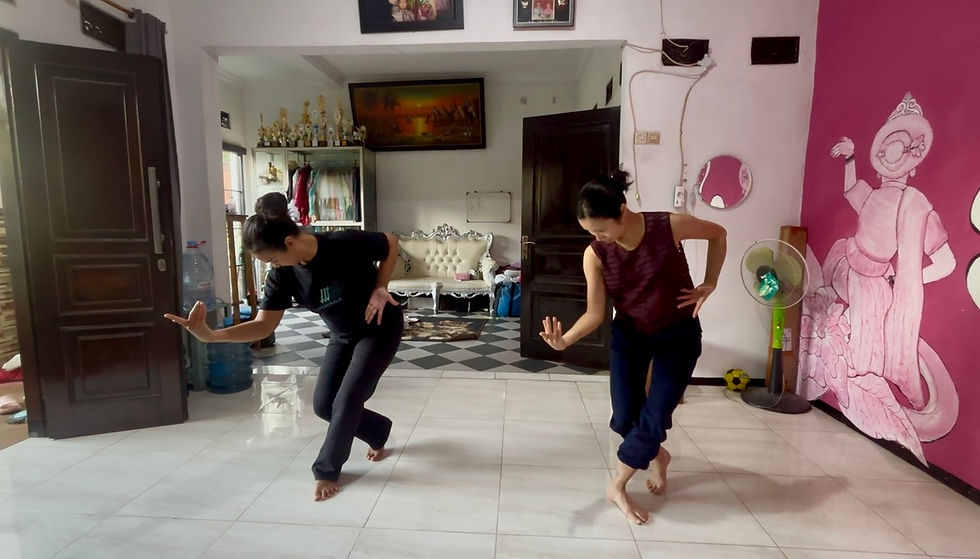
During this process, I realized that what she taught was not purely traditional dance, but a blend of traditional and modern forms. Upon asking, I learned that it was choreographed by a transgender artist in their 30s or 40s. He was originally female and had transitioned to male after surgery (I really hope I can chat with him sometime!). Looking at the dance steps, he fused Jaipong, Voguing, and other styles into a combination of elegance, tradition, power, and gender fluidity.
I then looked further into Jaipong and realized it wasn't a ancient tradition either, but a relatively recent creation with a history similar to contemporary dance. It combines various Sundanese folk dances with martial arts (pencak silat) to form Jaipong, complete with distinct roles for men and women. Is tradition truly static? Was what we call "tradition" once the "contemporary" of its time? How long must something contemporary endure before it becomes recognized as tradition?
Bandung doesn't have a formal contemporary art ecosystem. Dancers graduate from university dance departments only to face "unemployment." She once showed me her graduation piece, which featured a group of traditional dancers wearing sunglasses—a satirical commentary on how Dutch colonizers used to force Indonesian women to dance for their entertainment. This year, the graduation show I watched revolved around the story of prostitutes and poor workers falling in love with female dancers. Imagine that: even as they create works that respond to their era, when I asked about their career prospects, they told me that no such industry exists.
On regular days, Wawa teaches dance at the rural dance school, performs at weddings on Saturdays, and runs a TikTok account where she uploads her choreography—dancing TikTok moves in traditional attire. She mentioned having fans from all over the world, which allows her to connect with people globally while making a living. At that moment, I felt a strange sensation. Yes, they are dancers and dance teachers, but perhaps not "dance artists" in the institutional sense. Yet this is precisely the major predicament dancers face today. Rumy, a music graduate, works as a middle school teacher while doing music production for university performances on the side. The local ecosystem might be lacking, but everyone persists in doing what they love.
I remembered that right after I landed, perhaps because I was from Hong Kong, the driver noted that the high-speed rail connecting Bandung and Jakarta was built by Mainland China. The Grab driver kept telling me along the way that Indonesia owes a vast amount of debt to China, that Chinese goods are dumped onto the market at cheap prices, that their wealthiest citizens are Chinese-Indonesian, and that corruption remains a major issue. The entire country feels economically controlled. To them, they feel like people living in Indonesia under foreign economic influence. They care deeply about these power dynamics, yet feel powerless to change them. He said, "Think about a company like TikTok. It started with just four people coming here, and now it's a global empire. Indonesia has one of the highest user bases in the world." Because cheap goods flood in, the country becomes a market for inexpensive consumerism, and people naturally love cheap things. Is this a form of economic control? A form of economic colonialism?
When we talk about Asia, I pay close attention to exchange rates and economic flow. Looking at their economic mindset and reflecting on Hong Kong's condition, I began to understand why we must engage in Inter-Asian research. In a way, it is an attempt to find an alternative mode of exchange amidst the economic currents—not merely financial transactions, but genuine human-to-human and cultural connections. I care deeply about how to avoid "consuming" them. How can we achieve a more equal state of exchange?
The family running the dance school was thrilled by my visit. After class, the mother insisted on making a huge spread of snacks for us. The father was equally delighted by our presence and joined us for dinner. The school principal and his daughter chatted enthusiastically with us; despite the language barrier, we communicated through gestures and translation apps. They kept saying I was brave to come alone. Honestly, I didn't know what force brought me here either, other than a sense of conviction and trust—trust in her, above all.
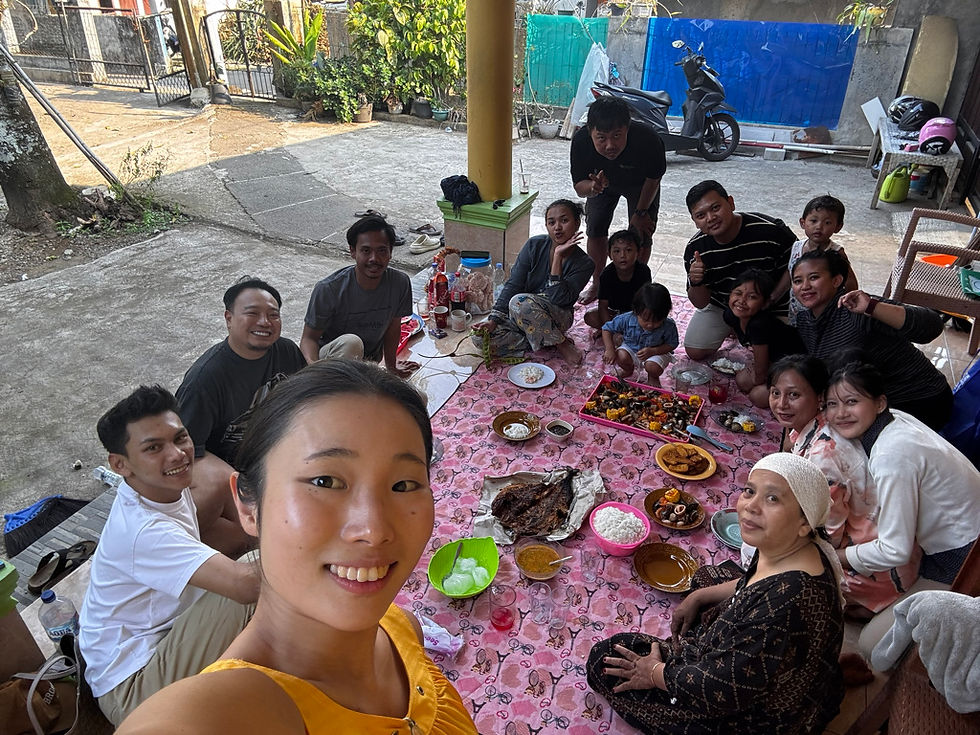
We sat on the floor eating with our hands while flies and ants occasionally competed for food. We simply laughed and brushed them away. To be honest, I would have had a breakdown if this happened in Hong Kong, but being in a foreign land, I gradually adapted. Luckily, my stomach held up fine; I just wasn't used to squat toilets, wet bathrooms, or places without toilet paper, and felt a bit embarrassed every time I brought out my own tissues.
When they heard we were going to the seaside, they immediately wanted to join in. They offered to lend us costumes and said we could take them whenever we needed. Then, they invited us back the next day to teach a class and gather the attire.

That night, once we finalized the driver's schedule and car rental price, we made the decision to head to the ocean. At first, I worried about whether taking them away would disrupt their family routine with the kids. But it turned out their primary concern was financial. I asked, "Would you like to bring the kids along? Since it's a long trip anyway, if you don't mind, bring them as a family outing." Even though a nine-hour drive is tough for a two-year-old, they said the kids wouldn't mind as long as I didn't. I was thrilled at the prospect of bringing the children—life and art should be integrated into work anyway. At the same time, we contacted the caretaker at the coast, and I immediately booked our accommodations. Although the logistics kept shifting—such as picking up the temple keeper—these were minor details. What mattered most was their curiosity. Upon asking, I realized they had never been to that coast before; for the children, it was their very first time seeing that ocean, and for the older boy, only his second. Counting eight people in total, we planned our grand departure.
Regarding the concept of an "artist mother," I observed a fascinating cultural dynamic here. Because the extended family lives close by—aunts, uncles, siblings, grandparents—whenever I asked Wawa if she needed to head home to pick up her children, she would say it was fine because someone was always there. Whenever she works, she can leave the children at home or ask family members to drop them off at school. There is always mutual support. "It takes a village" is literally how life functions here. Therefore, the concept of a "working mum dilemma" doesn't really exist in the same way, because everyone supports each other's lives and careers.
Culturally, they explained that Sundanese culture holds immense respect for mothers. Every dance honors motherhood; every piece of music celebrates it. They view childbirth as sacred and hold deep reverence for maternal figures. In this village, women eat in the kitchen area—they prepare the food and sit down together to eat. There is deep respect for mothers, elders, and women raising children, and raising a child is never viewed as something that hinders a woman's career or artistic pursuit.
I remembered buying coffee near the Airbnb one morning. After walking around, the only open coffee shop turned out to be a family-run stall operated out of a house window. The owner told me, "My ice is clean because I make it myself. After dropping the kids off at school, I open the stall to run my own little business." I thought to myself: Indonesian women are incredibly resilient. They emphasize doing things with their own hands—balancing childcare with their businesses and passions. This is something you can only truly appreciate by being here. It made me reflect on how we outsource domestic labor in Hong Kong (a very different lifestyle, of course), and I couldn't help but admire them. When I used to ponder "what institutional support is needed to balance childbirth and career," I realized that was a fundamentally capitalist way of thinking.
The next morning, we went to the dance school early. A large group of young girls was waiting for class. They eagerly waited for me to share my warm-up routine. To me, it felt natural, but in their eyes, it was an exciting moment of sharing movement and play across different cultures. Afterward, during their rehearsal class, I sat on the side watching various traditional styles, paying close attention to how the dance teacher taught. They were deeply invested, every gesture full of intention. They were exceptionally hospitable, buying fruit juice and preparing snacks and lunch—it felt like a family-run school. After class and lunch, we set off for the city center to watch the graduation performance.
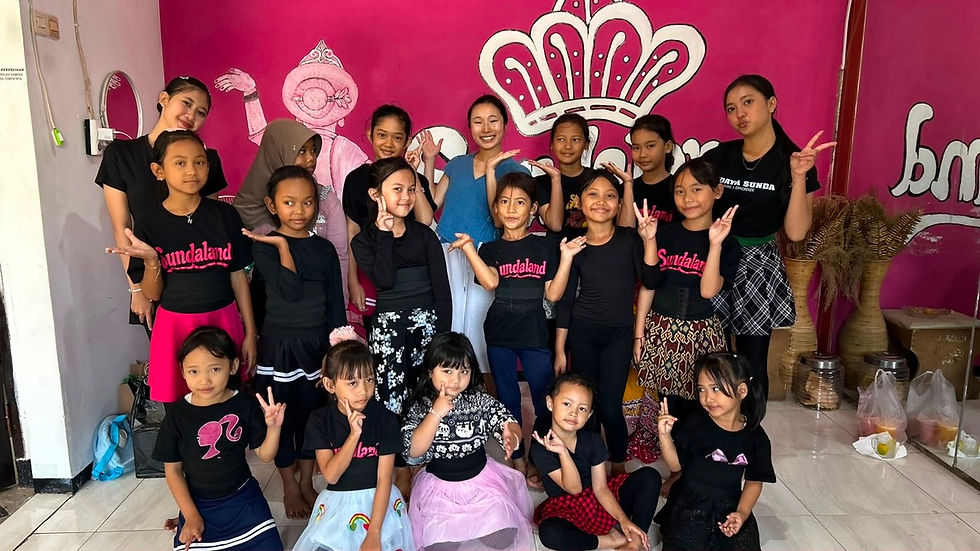
During the process, we packed the costumes. I knew the goddess's sacred color was green, but I asked, "Should we avoid wearing green by her ocean out of respect?" So we packed a set in red and gold instead. I still had doubts about the attire: after learning for just one day, was it appropriate to put on traditional costumes right away? Was this a staged photo shoot or a ritual? Should it be more contemporary?
Without much time to ponder, I visited a cafe and explored the city before heading to the train station. Bandung felt like a second- or third-tier city, carrying a relaxed pace. Watching the graduation show gave me insight into their university dance department. The professors seemed encouraging, wanting students to enjoy their performance. I also met a choreographer who combined traditional dance postures with contemporary movement. Though still influenced by the male gaze, it felt like a meaningful starting point. Afterward, we sat at a roadside stall eating local duck rice, listening to their casual chatter, and spending a simple evening together. We rode motorbikes back, which took over an hour. When we returned, I saw the bamboo prop for my Jakarta performance that Romy's brother had bought. It was a bit too thick, and I felt bad that they had to go out of their way for my performance props, but they were genuinely eager to help and offered to check for another piece in the morning.
On the third day, I visited a carving museum built by a Balinese artist who lived in Bandung, who was somewhat of a local icon. He built this museum as a place of creative sanctuary. (I also finally found a proper restroom! ^^) While the works leaned towards Western techniques, I was amazed by his critical mind—his grief and anger over Indonesia's reality, expressed with sharp humor. Faced with an unchangeable status quo, he responded through art in a constructive way, engaging directly with power structures.
After noon, we set off to pick up the temple caretaker before heading to the beach. Along the way, we met the dance school principal's family, who took another vehicle to their ancestral family home. After navigating nine hours of heavy traffic, we finally arrived. The moment I stepped out of the car, I found myself standing before a Guanyin (Goddess of Mercy) Temple. I was completely stunned—
The ritual was originally said to take three hours, and I had worried it might involve intense trance rituals. But they explained it was a quiet, contemplative prayer. They didn't mind entering together and were curious. Communication here felt serene; to them, praying to the deity was a way of knowing oneself. More importantly, they told me that before my arrival, they had already received the Goddess's permission. All we needed to do was prepare the flowers. They mentioned these flowers were quite expensive and rarely prepared in such abundance under normal circumstances. But the flowers looked so familiar to me—the moment I set foot on the ground, everything clicked.
I asked, "Why a Nanhai Guanyin (South Sea Goddess of Mercy) Temple?" They explained that this was where they established a resting room for the Goddess. I had always assumed it was in the famous tourist hotel room, but finding it inside a Guanyin temple felt far more sacred. Looking at the architecture, it didn't look entirely Chinese; the Buddha statues resembled local land deities (Tudigong), which felt familiar, yet the wall paintings of snakes and elephants reminded me of Thailand. I didn't connect all the dots immediately.

We arrived at 11:59 PM. They explained that praying on Saturday night was ideal, whereas Sunday was not permitted. So we truly arrived right on the dot. However, when we went to retrieve the costumes to be blessed by the Goddess, we discovered they were missing. We paced around the waiting hall in confusion, though without panic. I knew I had personally loaded them into the car, but the plastic bag in the trunk had somehow changed. As we changed clothes in the hall, they told me that the Sundanese dress I was wearing was actually the most appropriate and respectful attire for her. After preparing the flowers and taking a short rest, we prepared to enter the Goddess's room. The driver came inside with us too; he was exceptionally helpful, looking as if he was destined to be part of this journey.
We walked through a pristine white hall centered around a red pathway, which transitioned into green right before the Goddess's chamber. Portraits of various people lined both sides, though they didn't feel uniquely Indonesian. We sat on cushions, gazing through the window into the Goddess's room. Inside hung various portraits of her—there were no statues, only white flowers. Beside them sat a small photograph of a woman. A large green bed sat on the left, flanked by decorations and two chairs in red and green.
I wept for a long time inside that room. The people here inspired me deeply. They didn't care about money; they welcomed me with overwhelming hospitality simply because a friend had come from afar. One family connected to another, spreading the word from one to ten, and ten to a hundred. They were genuinely excited about a friend's arrival and proud to share their culture. It made me reflect on my work in Hong Kong and elsewhere over the years—how every second felt hyper-regulated, plagued by a constant fear of being disrespectful, stemming from past experiences and reflections on my family of origin. When I care too much, the invisible pressure I place on myself burdens the artwork. But their warmth made me realize that art is ultimately a way of giving back to culture and life—it revolves around human connection rooted in respect. There was no concept of "cultural appropriation" here, only pure exchange and communication.

After coming out, I asked many questions: Why a Guanyin Temple? Who was the woman in the photograph?
Upon asking, I learned she was a Thai priestess who, several decades to a century ago, had a vision in a dream where Guanyin instructed her to build a temple by this coast. She traveled all the way from Bali across Java until she found this exact landscape. Here, she built a temple blending Chinese and Thai architectural elements while honoring the Indonesian South Sea Goddess (Nyi Roro Kidul). To her, this was not merely a place of worship, but a sanctuary for reflection and rest.
They kept telling me that the deities present in my own culture exist here as well, just under different names in different places. To them, the South Sea Goddess is simply an incarnation of Guanyin—one and multiple, sacred and cross-cultural.
I had been wondering why a Hong Konger should undertake this research. I am neither Thai nor Indonesian—perhaps it connected to the culture of domestic helpers back home? But arriving here made everything clear: why learn traditional dance in Thailand first, and then learn folk dance here? When a Thai priestess comes to Java to build a Chinese-Thai style temple that deeply respects Indonesian traditions, and the local Indonesians hold her in high esteem in return, it proves that cross-cultural appreciation and integration are already alive here. They don't care where a culture originated; what matters is how traditions blend and respect one another. To them, spiritual culture is not singular, but multifaceted. They kept reminding me that this place holds high spiritual energy and that I could only arrive with the Goddess's blessing. Because Wawa was on her period, she couldn't enter the inner chamber, so she stayed outside chatting and planning the next day's shoot. They told me that I hadn't come here on my own accord—a higher force had guided me here.
We stayed for nearly three hours, quietly taking everything in. As we left, we passed the main Guanyin altar. Above her sat Thai deities; to her right was the Thai God of Wealth, and to her left were Thai serpent motifs (Naga). The altar also housed various Chinese deities, such as Mazu. (They laughed and said Mazu and I looked quite alike!) Stray cats followed us along the path, acting like our guides and onlookers. The entrance and exit had already laid the groundwork for this syncretic state: Thai deities on one side, Chinese land deities and murals on the other. It was miraculous how seamlessly they merged.
We returned to the car and headed to the hotel. Passing a chicken rice stall along the way, our group bought late-night takeout at 5:00 AM to eat together in the hotel room. I wondered why this part of Indonesia never seemed to sleep, even in a small coastal town.
When the big day for filming arrived, the dance school principal mentioned he would be a bit late because he needed to prepare the costumes. I was surprised—how could he find traditional costumes so early in the morning? Just as I was awkwardly saying it wasn't necessary, he said he had found them. As he unrolled the garments on the floor, they were all green! At that moment, I understood—she truly wanted green! She had already granted us permission from the start!

We excitedly put on the costumes and applied traditional makeup. The principal's family was equally thrilled; it turned out that with the grandmother's help, they had contacted a local dance school early in the morning to rent the attire and brought it over for us. I was deeply moved—it literally took two villages to make this happen, driven entirely by mutual support. I had no way to repay them in monetary terms; it was a unique, unrepeatable experience.
We then planned which beach to visit. Wawa's sister mentioned that the beach directly ahead was rocky, but she knew of a sandy beach ten minutes away with softer sand that they preferred. Just as I wondered if the driver needed rest, he appeared, ready to set off. Realizing the kids would have more fun on a sandy beach, we went to her suggested spot, which happened to be near their family's ancestral home. They warmly invited us to join them for lunch. I worried again about being a burden or running behind schedule, but they readily agreed: "We're cooking anyway, so come over! It's fine to be late!" The driver was excited too. You see, I had far too many worries—they had already hospitably arranged everything.
When we reached the coast, the waves of the Indian Ocean were extremely rough. On the right side of the parking area, many people were playing, but just three or four steps to the left, a small freshwater stream flowed into the sea from a river. There was no one around—it felt as if an altar had been prepared for our arrival. We took a few photos and videos on the rocky shore before moving to the stream. The children played happily, their joy infectious, and a local vendor came over to prepare fresh salad for us. With assistants, a photographer, and music playing, our shoot began.
During the process, I intentionally gazed out at the ocean, feeling the power it imparted and the connection it forged. The specific choreography was no longer the sole focus; much of it lay in our interpersonal connection, the spatial presence, and the encounter with the sea. These improvisations were grounded in the present moment rather than staged poses. Of course, I also helped her shoot some TikTok videos. Though it felt a bit surreal at times, I realized this was an authentic part of their contemporary culture.

After filming, we went to the principal's ancestral house for lunch, where we changed out of our costumes, returned the attire, and enjoyed a massive seafood feast they prepared for us. I reflected on how hosting friends in one's own home using local ways represents a truly fair concept of exchange—your consumption and habits reflect local life rather than an extractive, cross-border imposition. Could "locality" be understood simply as a way of living grounded in a place?
After lunch, since Wawa's sister spoke English, she served as our translator so I could ask the temple caretaker a few questions. He explained that he moved the Goddess's shrine from the hotel room to the Guanyin Temple because tourists had behaved disrespectfully in the hotel room, ruining its spiritual energy. After working there for over a decade, it was time for a change. His main profession is a wedding makeup artist, and he also applies makeup for the woman chosen to represent the Mermaid Queen. He mentioned that in the past, the Queen herself chose her human representative, but nowadays the role is sometimes bought by wealthy and powerful figures.
I asked, "Are you primarily responsible for serving the Mermaid Queen? How did it begin?" He replied that it wasn't something one could avoid—he had been summoned by her since childhood, and not everyone who serves her is female. Ever since he began serving her, he felt a deep sense of inner peace. He turned to me and said, "You were chosen to come here." I replied that since arriving, I felt a profound sense of peace—gentle yet powerful. It was no longer about asking "Why do this?" or "Am I qualified?", but simply knowing that it had to be done: to share their stories and culture with the world.
To be honest, their technical dance vocabulary was not vast, nor were they "artists" in the conventional institutional sense—they were simply children, teachers, and community members. But what I truly gained was genuine human connection and a transformation in life and mentality that transcended dance alone. Of course, there is always more technique to study, but the experience shared with them is one-of-a-kind. It deeply transformed me, teaching me to trust my intuition and embrace true reciprocity.
Comments